Wednesday, March 25, 2015

Journal 7: Ian Webster

Part One:
Overall i would say that my writing has come around a decent bit since i started the class early. I thought that writing was really just something that you either had or you didn't, but i now know that is certainly not the case, and writing is a craft that takes a lifetime to master. The exercise that i really had the most fun with was also the Moment in Time exercise when we had to create a fictional narrative based off of our preconceived notions about someone seen through a photograph. This really teaches you to think critically because you are suppose to put yourself in someone else's shoes, and try to comprehend what life is like for them. Anything goes, with that assignment, and i think that method of writing really has an effect on what we are doing right now with fiction. I intend to strive to learn how to write in anyones shoes, thats where writing is fun in my opinion.

Part Two:
1. A character does not immediately come to mind because after all i do not read that much fiction, and whenever i did, it was for school. But one book that really stands out in my mind is The Outsiders by S.E Hinton. And this is going way back, to like eighth grade probably, but i don't really care because as far as I'm concerned that was the book that was the most fun to read. The adventures of Ponyboy and his brothers as they navigate their way through a society that resembled many gang-rattled cities. The greasers and the socs battles were the stuff of legends, and a life lesson is taught through Ponyboy, to never turn your back on your family and the people that really made you who you are. He acted with bravery, determination, and most of all wit considering the way he dealt with his combatants.

2. I would consider myself a pretty big movie buff, but one movie that really blew me away was Interstellar. Matthew Mcconaughey seems so lifelike and real in a movie that takes the science fiction genre to the very brink, Anne Hathaway also plays the female protagonist role to perfection.
. The plot is what is most amazing about this movie, they way it is set up and giving you little snippets of information, scene by scene, which inevitably all makes sense in the end and how all of life is connected in some way or another. Yet the story seems real and it seems like a genuine problem that future generations might face. Hey maybe we can learn a thing or two from this movie.

Journal Seven, Dana

My best writing so far this term was the one with the photograph prompt. The entire piece was kinetic, and I managed to mix the dialogue tags, the action, and the dialogue perfectly. It somehow managed to be both fun and tense. Plus, I really enjoyed writing that character. She's a fun, feisty woman I haven't touched in a very long time, and I rediscovered everything I loved about her in the first place. I think that what I've most improved in my writing is my ability to be self-contained. I'm working on a long project, so a good deal of my work isn't self contained. It's supposed to be read within larger works that intertwine with each other. But I think I'm getting the hang of giving just enough context to serve the story without starving my readers or overindulging them. My goals for the last five weeks of class is to continue to work on diversifying my sentence structure in narratives. I took this class because I felt like I was growing stale.

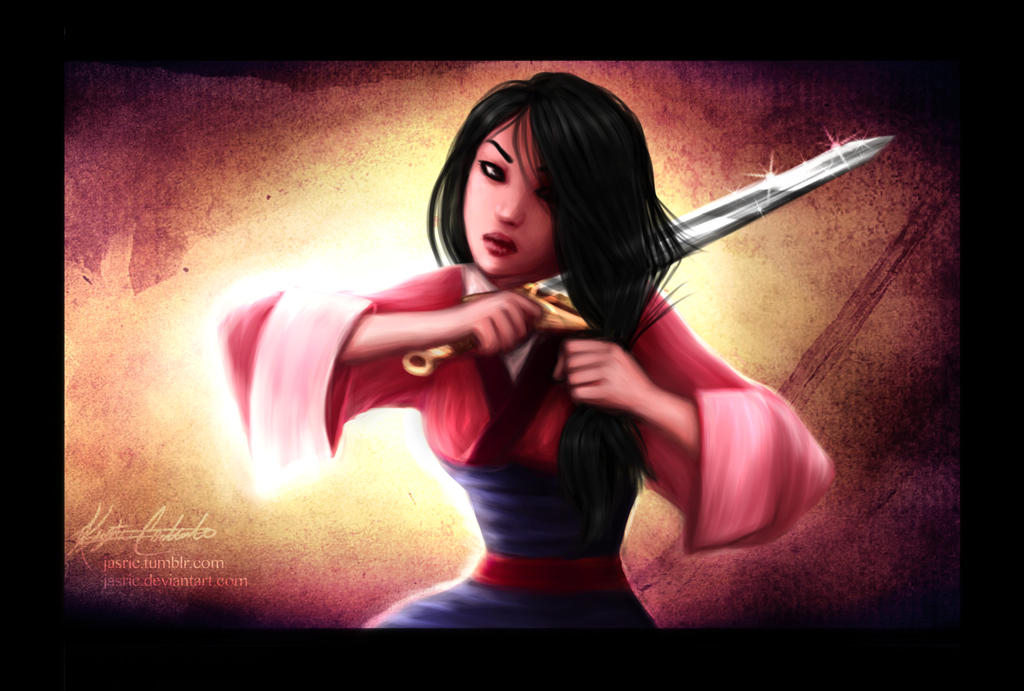
http://fc08.deviantart.net/fs70/i/2012/070/2/e/mulan_by_jasric-d4sew53.jpg

I think the fictional character in popular culture is Mulan. I know that as a reader, I should pick a literary character, but the fact of the matter is that books don't reach the most important audience for the future of American culture. There are three and four year old girls out there who aren't encouraged to pursue their unfeminine interests. Three years old is an impressionable age. Three years old is when you decide what you like and don't like. I remember when I was that young. I remember all of the Disney Princesses. I remember which princess wore what dress. It wasn't that I wasn't interested in science and engineering, but those things weren't presented to me as things I should be interested in. Then, there was Mulan. A woman who was pretty, but not comfortable just being pretty, so she went out and became a man for a while. And she kicked butt as a man and won the admiration of the men around her. She was turned aside for being a woman, but then she accepted her dual nature as a mix of masculinity and femininity, and she saved all of China doing that. That final fight scene, where she physically fought with fans and the like, that left an impression on me. The symbolism of her strength as accepting both parts of herself, with those fans... She was the strongest when she did that. I didn't get the complexities of it, but it opened a whole new way of thinking for little three year old me. Other girls need that, too, and more of it.

https://blogger.googleusercontent.com/img/b/R29vZ2xl/AVvXsEjssOvQ7C9cOv9BaX_oljVuB1SOy3_5VZEJzyJO8iglLAZ2yT60SIA1xxr2PRc6ogO6jvPt3BrA27FmJCNehq4yGPZrBmfIrHqDBf0wsvQhsLTa59dPZd4UoHePmOkwCvmB8gJJS0QoSgpI/s1600/angel-a+(1).jpg

If I had to recommend a have-to-watch movie, I think I would recommend Angela. When I think of magical realism, I call back to that movie. It has such an exciting, thrilling atmosphere... Something about it elevates it above a simple romance to something genuinely lovely. It's dirty. It's gritty. It's unapologetic. And it's heart breaking. I always cry when I watch it, and I didn't cry when I watched the opening scene of UP, just to let you know how serious that is. I have a soft spot for tall, in control women, and Angela takes the cake.
The IMDB doesn't do it justice.

Journal Seven By Megan Wittkopf

Part one:

I love my short-short story exercise with the picture. I love this story because I was able to make the story and characters relatable. I also love how I was able to show a life span through the story. When reading and writing now I am more aware of making a setting known in my stories. While reading I can picture the rise, resolution, and conflicts. I love knowing more terms like indirect and direct dialogue. Something I didn't know was short-short stories and learning about them, they have become my favorite type of writing (other than poetry). My goals for the last five weeks is to make my writing stronger and thicker (more detail). I have never written non-fiction fiction, so I am excited to learn about it. My final goal is to make my portfolio, I am very excited to have my work bind together and to show my family. My final goal is to go back and fix my work so it is perfected for the portfolio.

Part two:

1. My fictional character is Ponyboy from The Outsiders, S.E. Hinton. Ponyboy is my favorite because I love how genuine he is. Ponyboy and his friends grow up as street boys who learn through tough lessons (fights on the street, stealing, death). I love all of S.E. Hinton's books because she began writing at 16 years old.
2. I LOVE James Dean. Rebel Without a Cause is amazing. I had to write a paper about it my junior year and looking deeper into the plot Rebel Without a Cause is emotionally deep. Jim Stark (James Dean) is a rebellious teenager because of his life at home (parent's fighting) and takes on the role as a role model for Plato without knowing.  Jim also falls in love with Judy (Natalie Wood) because he is searching for the love his family doesn't give him. Jim always feels like he needs to prove himself by accepting dangerous challenges from other people (Chickie and racing). I love this movie because James Dean was an amazing actor and can speak to you through all of his body movements ( I also may think this because I am overly obsessed. haha)

www.youtube.com/watch?v=wXRgAXU1-T4 (Trailer just in case you've never seen it)

HE IS SO HANDSOME!

Journal Seven By Katie


Part 1:
My writing thus far has only improved because I didn't write and so the fact that I am writing now is an improvement. I have learned that I truly enjoy writing and want to take more classes for it in the future. So if anything from writing I have learned that I enjoy it. The writing exercise I believe has been my best has been my form poem. I felt I packed a punch into a small amount of writing and conveyed my feeling thoroughly. In my reading awareness I have learned that sometimes for the writer things come out of the blue and they are just as surprising for them as they are for reader. For the last few weeks my goals are to challenge myself in my writing, learn what I enjoy writing and don't enjoy, and to continue to try and find my own voice. I am aware that these goals will most likely not be accomplished in five weeks, however I hope to be able to take a step or two into the direction of me completing them.
Part 2:
     1) Trying to think of a fictional character that means the most to me was very difficult but I have settled on Jacky Faber, the main character from the Bloody Jack series by L.A Meyer. In these books she has lost her family while young, learned to survive as an orphan, gained an education, started a worldwide business and traveled the world. She is a quick learner, adventurous, witty, clever, as though scared a lot, she pushes through her fears because she knows  that she has to. She knew she wasn't perfect and admitted that very often, but she knew who she was and accepted the consequences of her actions when she had to. She is not the most perfect role model, but reading her stories have never failed to make me smile, not matter what else has been going on in life.
     2) The movie I am going to recommend is Good Will Hunting. I just recently watch this movie about two weeks ago and have watched it two or three times since. It's a drama but not a sappy, sad drama. It's a drama about a young intelligent man's life and figuring out who he is. The dialog is great, as is the directing and acting itself. It stars very young Matt Damon and Ben Affleck, and Robin Williams too. It is a bit intense but you feel a happy contentment at the end which I find nice. It is kinda long, like 2.5 hours but worth every minute.  Heres the movie cover:


Side note: The movie started as a college assignment for Ben and Matt. They had to make a 1-scene play and few years and money to make it later... Voila! This was created.

Journal Seven by Maddie

Part One:
One of the best exercises for me was exercise 7, This Moment in Time. For this exercise we had to pick a photograph and write in the voice of someone in the photo. I feel I did well with it because I had a lot of fun with the prompt. Exercises that had prompts less appealing to me I didn't do as well on. But for this one, I really enjoyed taking on the voice of someone from a real photograph. I could create whatever story I wanted to tell about them. As a writer and reader, I have started paying more attention to the word choice and tone being used. The words that are used are very important and can have a large influence on the story, much like the tone. I have become more aware of who the narrator is in my own writing and how to make the words and tone match who is speaking. In these last five weeks, I hope to improve on my actual writing process. When writing stories, I tend to just jump in and see where I end up. I found myself doing that with the 4-7 page story we are using for workshop and without a solid direction, I got stuck a lot. I think by doing it this way, I'm making it harder on myself so I want improve my process.

Part Two:
One of the most meaningful fictional characters to me is Jay Gatsby from The Great Gatsby. He is so intriguing as a character. I remember the first time I read the book I was in love with all the dimensions of his character because you can't quite figure him out. He fascinates you and draws you in because everything about him is a mystery. F. Scott Fitzgerald did an amazing job of creating someone that appeals to everyone. In the book and movies, the women wanted to date him and the men wanted to be him. In some sense, that holds true outside the story.

I would recommend others to watch Stuck In Love. It's not as big of a chick-flick as it sounds, I promise (plus it's about a writer). This movie has a variety of characters, so there is bound to be someone in this story everyone can relate to. There are a lot of powerful relationships between the characters, along with many emotions being expressed throughout. I'm pretty sure you can experience every emotion while watching this movie, without it being overwhelming. Bonus: it's on Netflix!

Wednesday, March 11, 2015

Journal 6: Ian Webster

Part One:
For me two interesting pieces were Hitman and Girl:
Well actually i wouldn't say Girl was one of my favorite poems, but it was just so interesting to read. These two poems are complete opposites. One literally documents a mans entire life from the big deals right on down to the small details. In Girl you have no idea the setting, the time frame or anything like that. It really is just providing a snippet into someones life, a life that no one knows anything about. While Hitman was quite the opposite considering it really documented this mans entire life from beginning to end. But a similarity could be that they are both two unorthodox writing styles that really flow in their own unique way.

Part Two:
I read it over a couple times to really feel the effect of the story but Reunion  definitely struck a chord with me. I liked it because it is so vague, and yet it is so clear, not like this statement. I think that the plot line is first of all unfinished, but also there is not enough of a backstory to really understand this story. But i liked that because it puts you in the moment, and makes you really visualize the story and what is happening. The story is essentially a father and son meeting for the first time in a long while, and the meeting not going quite how the kid hoped to put it in a nutshell. What this means to me is unclear, really, because i am still unsure of how i am suppose to approach this story, I'm not really sure what is suppose to mean to me, but it sure was entertaining. I think a reader can learn some good and bad elements of writing from writing in this certain style. I think that if u write using this notion that you are suppose to let the reader sort of figure out the situation for themselves, you have to give little cues in the story that can create an image in someones mind. Like the first sentence, he starts off by saying "The last time i saw my father was in Grand Central Station", you instantly know from that sentence that he is more than likely reflecting on a bad memory. My favorite word or phrase in the story i would say is Daddy, because this was him basically letting go of his childhood, essentially letting go of what paternal prescense was in his life, which would remind him of his childhood. The most important sentence i believe isn't really a sentence but a phrase "This isn't England". This i think sums up how everyone else feels around this man like the servers who are suppose to wait on him. How would you be able to be nice to a man like that?


Web reading exercise on Flash Fiction or Short-Short stories. From Mike Lohre.

 Dear students and fellow writers:

We've read some flash fiction, or short-shorts.  Now let's hear from some writers, and explore the limits of the genre.

Have fun, and I'll look forward to your responses in the Comments section of this post.

Mike


Going Long. Going Short.  Opinion pieces by writers in NY Times.

http://opinionator.blogs.nytimes.com/2013/09/30/going-long-going-short/?_r=0

The Story Behind My Very, Very Short Stories.

http://6thfloor.blogs.nytimes.com/2012/08/27/the-story-behind-my-very-very-short-stories/

“The Margin,” by Curtis Sittenfeld
In 1987, when Jenny Ficker and I were in sixth grade, our goals were to have a double wedding at which we married the McMasterson twins, to trick my sister into drinking a glass of pee and to sneak in the middle of the night to Boland Square and put a bra on the Grecian-woman statue on top of the fountain. Weirdly enough, I did marry Andy McMasterson, but I lost touch with Jenny years ago; whenever I drive by the Boland Square statue, the bronze bosom still hangs there for everyone to see.
“The Femur,” by Curtis Sittenfeld
On my 21st birthday, my father revealed two facts about himself: that he was colorblind and that before I was born, he’d served four years for armed robbery. I suspect the colorblind disclosure was a test of my maturity, and if I’m right, I must have barely passed. After he told me, I became petulant and said, “I just think it’s really weird you hid that for my whole life.”

Students, please respond in the Comments section of this post:


1)  What strikes you in the writer's essays as important?  Do you agree or disagree that flash fiction is perfect for the busy, technological age?  Explain.  Use one quote from the articles somewhere in your response.


2)  Are these two examples of very very short stories really stories?  Why or why not?  Argue for, against, or both?! 

Journal 6 Katie Vance


Part One: Popular Mechanics and Bottle Caps
I feel like these two stories are the most different because of their tone. Popular Mechanics' tone is very harsh and anxious. I felt like I was walking on eggshells the entire time I was reading it. In Bottle Caps though, it felt like the tone was "matter of fact" like she would tell this story in the same tone if you asked her what time it was. Another difference between the two are the ages of  the main characters. In Popular Mechanics, the main speaker was an adult while in Bottle Caps it was a young child. A similarity between the two was the fact both stories took place at home. In Popular Mechanics, the father was leaving the house and packing his things. In Bottle Caps, the speaker talks about their collection growing in the basement and their backyard where their brother had and insect graveyard.

Part Two: The Old Badger Game
This was my favorite story out of the 7 because it talked about badgers and it made me laugh. I think this story means to not dislike others for living a different life from your own. Though it is a different life, there may be more similar problems between the two than originally thought. A writer can learn a lot about personification from this story. Annie Proulx wrote about badgers having jobs and being retired and did a fantastic job of it too. The most important word would have to be rancher. This is because it helps with setting, and what some of the characters do for their job. It allows for the badgers to be in the story in a realistic setting of their natural habitat. This helps make the personification seem more realistic. The most important sentence was " 'Good looking badger,' she said aloud, imagining herself in a coat of the same red hue, not necessarily a fur coat- a faux fur would do, or even tweed with a monkey collar." This is the most important sentence because it is the lever in the story. It pulls the first half of the story into the second half where the conflict lies seamlessly in one sentence.

Journal 6 From Megan Wittkopf

PART ONE:
Popular Mechanics is a short short story about a husband leaving his wife and wanting to take the baby with him. The short short story's setting is in a house. It is also written in 3rd person limited, unreported dialogue, and has one conflict. The conflict is also extreme because some of the actions performed with the baby are unrealistic (baby was in the middle of a tug-of-war)

Bottle caps is a short short story about a guy who likes to collect all sorts of bottle caps.  His younger brother has been taking his bottle caps and has been using them as headstones for his dead insects. The short short story is written in first narrative reported dialogue, only has two characters, and one conflict (brother taking the caps).

Similarities:
short short stories
both have conflicts

Differences:
Both are written in different dialogues
Popular Mechanics has a more relatable conflict
Both are written in different voices

PART TWO:

My favorite short short story was Reunion by John Cheever.

1. Reunion is my favorite story because it reminds me of my father, somewhat. My father is not as extreme but he would get into ridiculous conflicts with cashiers, people on the phone, etc. When I was younger I was embarrassed but now I understand why he was mad! It also could be I have his temper!
2. What I got out of the story was an adult man traveling by train and had a stop in New York. His father was not around as a child so he was looking forward to seeing him. When his father met him he seemed cool till they end up going to four different restaurants because of his father's rude behavior. By the end of the story the son left and never visited his father again. What this story related to me because I am a server and I have had people treat me in the same manner. I just don't have enough courage to tell them to leave. What is sad is there are a lot of rude people like this.
3. A writer can learn how to change scenes like a circle and ending in the beginning. For example the story starts at the Grand Central Station and moves to 4 different restaurants and ends back at Grand Central Station. The writer also introduces us to 5 different characters other than the main 2 characters. What a writer could learn from this is that you can introduce many characters with a small but huge role. Without the servers (small role) we wouldn't be able to see the rudeness from the father (huge role).
4. The most important word is boisterous because it explains the father's attitude. Boisterous means noisy, rowdy, which when his father was being rude he was being loud and rowdy to be heard from everyone, as if he wanted the attention.
5. "Now, just wait a second, sonny," he said. "Just wait a second. I want to get a rise out of this chap." This is an important sentence in the story because the sentence proves that the father was acting rudely to see how far he could push the servers/employees. It seems like a game to him to act rude and to see if someone will act rude back and how rude they will go (like a shouting match).

Journal Six

I know it's strange, but I think that Popular Mechanics and Reunion are the two most different stories. It's a matter of tone, really. The tone in Reunion is wry and sly, like it's winking at you out of the corner of its eye. Popular Mechanics is dramatic and understated, and each sentence is packed with tension. The more I read of Popular Mechanics, the more nervous and anxious I became, because while it started out bad, I know as a reader that short stories like that tend to only get worse. The more I read of Reunion, the more I relaxed. I laughed, even, and wondered how much more troublesome the father could be. Reading one after the other was a serious cause of cognitive dissonance.

I think my favorite short story out of the selection was Symphony. I wish that I could put a date on when it was published for more context, but I can't. It seems to explore the life of a supposed slut, and how fantastical people make it sound. In places, it's remarkably tongue-in-cheek- "I woke up in Phillip's bed. Come here, he's in my hair. You can smell him."- and in other places, it's quietly poetic: "After the only part of him I will ever hold collapsed inside me he said 'You are so incredibly gentle.'" I think the best craft to take away from Symphony is that you often need to go outside of your comfort zone to find topics to write about that no one else has written about, to be original. So many authors shy away from talking about sex and love in fear of being thought of as silly and frivolous, but there's so many unexplored complexities and nuances in those two concepts.

Sacred is possibly the best word in the story. It's strange in a story about a woman who sleeps around often, with so many people that the act of sex isn't special, but that makes it stand out more.

Sacred:
a :  unassailable, inviolable
b :  highly valued and important <a sacred responsibility>

Sacred means precious, beyond reproach. It's a word associated with religion and a higher power. 

"I lost fifteen pounds and the men want me again." I feel like this is the most important sentence in the story because it's so ridiculous, and it calls back to the sort of nasty things ladies say about one another. "She got skinny and now she's a slut." The entire story gains perspective with this establishing sentence as being fantastical and silly. 

Journal Five

Dear Mr. Levine,
We watched a DVD interview of you in class a while ago. I was surprised by how... Down to earth you were. I have this fixed image in my head of the stereotypical poet being a dark and brooding young man who wears fedoras and shaves his beard into the shape of a goatee while sipping on a starbucks latte. It took me ten minutes to realize the backdrop of the interview was an outside gym. You look so unassuming. I would have figured you for a blue collar worker, not a poet.

But you are a poet! I admit, I wasn't paying much attention to the film until you started reading M. Degas Teaches Art And Science At Durfee Intermediate School, yet it caught my wandering ear and kept it for its entire duration. I grew up attending mediocre city schools. I was the Gertrude of the class; always over-sharing and never wrong. Oh, who am I kidding. I'm still Gertrude to this day. You can ask my professors. Your reading of that poem made both me and the class laugh, and it called me back to a bright spot in my childhood.

I hope the other side appreciates you more than we did.
-DD

Journal Six from Maddie

Part One: The two poems that I feel are most different from each other are "Reunion" by John Cheever and "Girl" by Jamaica Kincaid. In Cheever's story, we get full sensory details of an event that was over in an hour and a half. In Kincaid's story, we are seeing glimpses of her life over a continuous time span. A large difference between these two stories comes from the construct of "Girl". The story reads more like a list, composed of rules that are being said by a character we never meet. Also in this story, there are a few sentences that seem to be unreported dialogue, coming in the form of questions. "Reunion", however, is formatted much differently in that it uses reported dialogue and relies heavily on on the dialogue happening between the two main characters. A final difference between these two stories is the way the author reveals setting. In John Cheever's story, we are immediately told where the story was taking place. after the first two sentences, we know a father and son are meeting in Grand Central Station in New York to get lunch. In Jamaica Kincaid's story, we get clues throughout that suggest a setting. Some of these clues, such as benna music, doukona pudding, and many others, let us know that the narrator of the story is from a culture different from our own.
Both of these stories are told in the same first person point of view. For "Reunion", we see everything from the point of view of the son. We get his thoughts a feelings as he tells the story of the last time he saw his father. In "Girl", there are two lines that suggest that it is also written in first person. The unseen character is giving the narrator guidelines and the narrator responds to only two of them. These responses are italicized in the passage. The narrator says "but I don't sing benna on Sundays at all and never in Sunday school." The use of "I" is evidence for a first person point of view.

Part Two: 1) My personal favorite was "Bottle Caps" by Stuart Dybek. I thought the story had a charming tone, except for the climax of the story when the narrator found his brother stealing his bottle caps. I also enjoyed the resolution that followed the climax when the narrator found out why his brother was stealing them, which gave it an amiable ending. 2) I interpreted this story exactly as it was read. I pictured two young boys finding a way to pass their time in the summer. The narrator had the hobby of collecting bottle caps, something he is very proud of. And the younger brother enjoyed burying insects in a self-made graveyard. It gave me the impression that it took place many years ago since I never heard of kids today collecting items out of the trash or creating things in the dirt. 3) The writer does a great job of using sensory details to make the reader feel what the narrator was experiencing, "The coffee cans stashed in the basement began to smell- a metallic, fermenting malt." The writer also uses the perfect amount of dialogue. There are only two lines but the writer could have added more or less. But with only two lines, it was enough to capture the moment of what was happening for these boys, but not too much that the story relied on it. 4) In this story, the most important word the writer chose to use was "hoarded". Up until the very end, that one word captures everything the narrator is doing with these bottle caps. They were so important to him and he held onto them so much, that they became beautiful to him. When we hear the word "hoard", we give it a dirty connotation. In reality, the word "hoard" isn't a negative term, it means a supply that is hidden or carefully guarded for preservation or future use. While many assume that hoarding means living in filth, the narrator of this story thinks what he has done is beautiful. 5) The most important sentence in this story happens to be the very last one, "I've been using them as tombstones," he said, "in my insect graveyard." I love that the story ends here, because it didn't have to. The entire story, we are given the impression that these bottle caps mean a great deal to the author. Even though he has more than he can count, and so many he doesn't notice when some went missing, he still refuses to get rid of any of them. When the younger brother tells him he has found a new purpose for them, it leaves us with the impression that maybe the narrator will appreciate the usefulness his bottle caps serve and accept it, rather than stashing them away in coffee cans in the basement.

Monday, March 2, 2015

Journal 5: Ian

Dear Mr. Levine,

I was really captivated by your interview. I really enjoyed how you put your life into perspective with others in order to make a bigger point, one of the few things i picked up on. You talked about how life growing up in Detroit was both a blessing and a curse at the same time, but you really didn't know why. I think it is really clever saying this because it is what you do with our very limited amount of time on earth, so you should exclude all of the bullshit.

I think it is interesting being such a distinguished writer and not really even being recognized for your work, but i think you made a good point in saying that it isn't that part that drives a poet, it really is done for oneself and oneself only. You don't do it for the glitz and glamour that some authors strive their entire lives for because that is really how they are going to make enough money to have anything evoking a normal life. But that doesn't matter, and thats how i think it should be with any profession, but obviously that will never be the case.

I enjoyed the poem You can have it, it seems like so many elements of writing are being put to use here, although it being for the most part a reflective poem. You are talking about how you could give your brother more than what you could give him at the time in the 1950's in Detroit, I really enjoy the thematic theme, and how it is a story. I really like the line "The City Slept. The snow turned to ice. The ice to standing pools or rivers racing in the gutters. The bright grass rose between the thousands of cracked squares, and that grass died". That is a case of sensory overload, to the fullest, yet you are also telling a story.

I hope to take what i have seen from you and apply it to my own writing, it might take some time and experience, but maybe someday it will come to me.