Monday, April 20, 2015

Extra Credit Movie Review. From Mike Lohre

 I have a movie that is up for review.

It is about the activist and graffiti artist Banksy and the title is Exit Through the Giftshop.  You can find it both on Netflix and Vimeo I believe.  The film is filmmaker Thierry Guetta's project to chronicle the underground world of street art.  His investigation takes a fascinating twist when he meets stencil artist Banksy.


The assignment: 

1> Take active notes, and you will turn in or send me a scan of your active listening as part of your points for this extra credit.  
2> Do outside research for terms and definitions needed to better understand the movie, the director, or a specific theme in the movie.  Include at least one outside source in your review.
3> Write a 2-3 page review of the movie.   Use MLA style.
4> Send me the finished review and your active reading notes at mikelohre@gmail.com  


Depending on the quality and coherence of your review, I will add from 1 to 3 percent to your OVERALL grade for the class.  This is usually engouh to bump you up one grade level (for example from a B- to a B or from a C+ to a B-.  

Have fun and good luck! 

This is due to me at mikelohre@gmail.com before midnight on Tuesday, April 28.

Thursday, April 9, 2015

Journal Eight: from Ian

Part One:

Its hard to put into words everything you have learned since starting the non-fiction chapter, because each story is different and teaches you different methods of writing. I have learned that it is best to know exactly what voice you are trying to write in because that can effect the quality of the piece. Like if you are writing in first-person you then have to make sure that all of the other elements of your story all add up, my short story became a casualty of that. The readers have to be completely aware of what message or point is trying to get made in the story, and my story did none of that. Most of the pieces in this chapter are Narratives, but there is one that looks so out of place and has some kid of effect on the reader. The El Toro Rojo piece by Dinty W. Moore stood out right away because of the length, I like stories that get right to the point, in other words I am still a lazy reader, but I am working on it. Never the less after I read the story I realized that it was one of the most brief, yet entertaining stories. First thing I noticed was the title, even though I failed Spanish in high school I understood the title "The Red Bull", and immediately I know it is a story about matadors and how they have the red flag thingy and that's what I like about the story, I don't want to have to dig to find out what the underlying theme of a story is, I want it right in the title. The second thing that stood out about this piece was the author, not that I knew anything about him (I'm assuming), but his name. What kind of name is Dinty, and what could that possibly be short for? I like how it adds intrigue to the piece and a real sense of mystery to the piece, is this guy (?) Spanish? Or is he just observing something like this happening as a tourist from the outside.

Part Two: The essay i chose is out of the Harvard Review, which from the sound of the magazine it sounds like something about it would be worth reading. I have never really looked online for essays like this because i am always just scrounging the internet looking for the next thing to read. I will admit that i do not have the attention span of a normal person like say someone who doesn't use social media.

http://harvardreview.fas.harvard.edu/?q=features/fiction/my-family-recalls-cookout-circa-1989

This is a story that makes you go way back, to remember a time when things were not as good as they are today, and you are able to laugh about the stories that you have been able to tell along the way.  The story summed up is of a family reminiscing about a memorable family barbecue, which took place in 1989, awkward year it seems. What i've learned from this piece is that you always have to be able to look back at the bad times and just remember, theres always something better waiting for you along the way. That is a very powerful tool in writing because it can take us to different times and places.

Wednesday, April 8, 2015

Megan Wittkopf's Journal 8

Part one:  what I have learned so fair from our Writing Short Creative Nonfiction is that we need five things to make the story:

1) Personal presence: we want to reveal a great deal about ourselves and format it like a memoir.
2) Self-Discovery and Self-Exploration: even in our essays we can learn as we go and become more reflective.
3) Allow for Flexability of form and take a literary approach: we need to borrow techniques from poetry and fiction.
4) Veracity: It needs to be a real experience and reliably factual
5) Blurs boundaries between genres: We need to be able to imagine and see what is written underneath your story.

You also need to remember your 5 R's: real life, reflection, research, reading, and riting when beginning your short creative nonfiction. It all sounds like a bunch of rules but if your being honest and writing about a real experience and we are able to follow and picture your scenes you've mastered the idea!

I think Liferower   taught me the most about creative nonfiction. Rebecca McClanahan had three elements to her story: working out, her families heart problems, and her abortion. She did have one major scene, using the rowing machine at the gym. This is the place where she was remembering these themes. McClanahan uses a organized tactic by using individual blocks to separate her train of thoughts. Rebecca pulls us into her story at the part when the girl is comparing herself to the digital woman on the screen and mentioning how "she does not get tired" and how she needed to train her heart to make it stronger (this makes us wonder what she's been through? and why does it need to be stronger?". I personally love the line, "The heart is controlled by two opposing bundles of nerves, the sympathetic and the parasympathetic." This makes me think about her being the heart (the person in the rowboat) and the two bundles of nerves are the rowing paddles on either side of her. She needs to be like the digital woman and never tire or take an extra second between rows because she needs to be strong for herself (heart). This woman is afraid to be alone, failure, confidence "The yoga master assumes the lion pose, crouched and ready. She bares her teeth, lifts her mane into the air", and afraid of depression, "you are alone and your life is a rented room.". The end of the essay taught me that ending your story strong is very important. I love the way Rebecca McClanahan ended Liferower. The last yoga pose described how the woman was actually feeling, broken, by assuming the child position, helpless, shoulders down, knees folded to belly, hands and feet at rest, ears open to the slightest sound. The music was similar to a heartbeat "a two part harmony" reminding her to train her heart to be strong.

Part Two:

https://www.creativenonfiction.org/online-reading/man-tracks

The magazine is a creative nonfiction magazine that sells for $10. Their recent issue was about memoirs. You may also submit your essays to them but they must fit the subject they are asking for.  I read an essay Man On The Tracks written by Erika Anderson. This story is about a man who steps on a train track and the writer describes the possible thoughts going through everyone's head, eventually 3 men pull the man off the tracks but they don't say anything to him and just walk away. The man yelled train but the narrator said he was not allowed on the train and that he was confused because the man seemed fine (not high, drunk, or sad). The narrator talks about how he told everyone about the experience and all the responses were insensitive to the man on the tracks. In the end no one was concerned for the man on the tracks but for some reason was concerned about the person who witnessed it. I think Anderson is taking a stab at society because we don't really think about the strangers. We are often selfish of our emotions. The narrator should've helped the man, but debated helping because he could barely hold his groceries. The 3 men who pulled him from the tracks just walked away and left the man there. Everyone is wrapped up in their own business, no one really cared for the man!

Journal 8 from Dana

Last year, I started to get seriously into creative nonfiction. I remember reading Whatever It Takes by Paul Tough and The Spirit Catches You and You Fall Down by Anne Fadiman, among other books, and what surprised me was how professional the tones of those two specific books tended to be in spite of their form. They shifted between being in scene, giving a narrative account of a time from the author's perspective while they were interacting with their subject, to giving hard, solid facts about their subjects. I wasn't used to that. I had thought all nonfiction was essentially a list of facts that were smashed together into the introduction-body-conclusion format. Impersonal. I had wondered if the books I were reading were strange, because besides the New Yorker, my only experience with creative nonfiction was dry, flavorless school texts. I didn't know that creative nonfiction was a bridge between storytelling and teaching.

What I've learned from the creative nonfiction chapter so far is that an essay doesn't have to be dry and impersonal to be quality. While I wasn't a fan of Montaigne, his essays really drove home the idea that the introduction-body-conclusion format wasn't the only way to go. "Someone, I have forgotten who, having won a naval battle, cut off the thumbs of all of his vanquished enemies, to render them incapable of fighting and of handling the oar." Someone? Who knows who! He could have been reporting on his time's equivalent of an urban legend. That reminds me of the "My name means..." piece I wrote for the fiction section of this class, which in hindsight is really more creative nonfiction. "I had read in my encyclopedia that a man named Dana won then Nobel Prize for literature which I cannot confirm the truth of day..."

http://www.newyorker.com/magazine/2015/04/13/the-price-of-a-life

The New Yorker, in the coming years, may become the last bastion of investigative journalism. There's no shortage of quality, and readers often complain that the amount of time it takes to read and digest one copy, the next one comes out. I don't like to pick and choose what I read out of it, myself, but there are so many hours in the day and an unending supply of things to read! The essay breaches the topic of exoneration by talking about a specific case of John Restivo being wrongfully convicted and then freed. Then, it starts talking about the damage of being imprisoned and then exonerated. It reaches out from Restivo's case to talk about more specific facts and information, then reaches out to give a little scene at one point of an office dedicated to exonerating the wrongly convicted.

Journal 8 from Maddie

Part One: Out the the three essays, I learned the most from Joyas Volardoras by Brian Doyle. Not only was it my favorite piece out of the ones we read, but I have never read anything else like it before. As students, we have all done research essays with facts and statistics, but Doyle showed us that facts and research really can be creatively done. Compared to Scott Russell Sander's essay News of the Wild, where all the factual information felt like knowledge he already possessed. More likely than not, Doyle did a large amount of fact-finding research to write his piece, "Unicellular bacteria have no hearts at all; but even they have fluid eternally in motion, washing from one side of the cell to the other, swirling and whirling. No living being is without interior liquid motion. We all churn inside." Never had I imagined someone could make facts about bacteria sound beautiful. Before this piece, I limited my creative nonfiction writing to subjects I was already knowledgeable about that required no research and mostly wrote about things that have happened in my own life. This is a style of creative nonfiction I would like to try. In the analysis of this piece, I learned another important piece of advice, and that is to put your strongest material first. Now, of course you need an attention-getter that's going to draw in a reader, but I have always believed if I put the best thing I have to say in the beginning, I will dry out by the end. Doyle followed this example, and it worked well for him. After telling us to "consider the hummingbird for a long moment", he jumps right in with all of these fantastic truths about the hummingbird. I do believe the first half of this essay is the strongest part.

Part Two: The magazine I chose is titled Sweet. I initially clicked it because of the interesting title, but I was greeted by beautiful photography that headed the website which made me stay. On the home page was a list of the essay and poetry writers that were published in the latest issue and the title of their work. Each listing was a link that would take you directly to their piece to read. I selected an essay by Chelsea Biondolillo titled Crazy, again, I was intrigued by the title. It was a genuinely honest essay about herself and how she never felt beautiful compared to her best friend. This piece really exemplifies one of the first qualities we learn from our textbook that personal essays should have, "The personal essay is conversational-often ironic, humorous, even "cheeky"-in tone." It was absolutely all of those things and was a lot of fun to read.

https://sweetlit.wordpress.com/issue-7-2/prose-chelsea-biondolillo/

Journal 8: Katie

Part 1:
From reading the creative non-fiction chapter I have learned how easily it can be for writers to make an opinion come across in a piece without overtly saying it. It comes out in the words they string together in their essay's. Brian Doyle, one can tell he is fascinated by hearts. He talks about hummingbird hearts, whale hearts, and human hearts in detail. He explains how magnificent they are without saying they are magnificent. He very directly points to his opinion in a way that is not misinterpreted by others. The story that has taught me the most about creative non-fiction would be Rebecca McClanahan in Liferower. She strung together many ideas seamlessly that made sense to me. I feel like  my mind jumps between thoughts much like the speaker's did in the story. It taught me that my pattern of thinking is a form of art that I was unaware previously. This can be seen in the lines "I pump my legs and pull the rope. In a large area beside the rowing machines, a yoga class begins. The instructor greets the sun, breathing in prana, the invisible life force: in through the nose, out through the mouth." While the whole time the speaker is thinking of the things happening around her, she is jumping from observation to observation with a flow that still ties together.

Part 2:
The essay I read: http://thenormalschool.com/mr-plimptons-revenge-by-dinty-w-moore/
 The story is in the little chat bubbles FYI.

The magazine I found it in was "The Normal School- A Literary Magazine". It publishes non-fiction, fiction and poetry on its site. I found the essay on the home page. They seem to have a new piece published everyday or about every other day. After more poking around on the site I have learned they publish bi-annually. It looks like the people who work there have a good sense of humor as well.

What I learned from the essay is that an essay does not have to look like a typical school essay. This writer used a map as a background and used it to help establish setting in their story. The writer also used text boxes/ thought bubbles to type in, which I found very light hearted and fun. The examples we read in the book seemed to more serious than this essay, so I appreciated seeing a less serious essay published.

Wednesday, March 25, 2015

Journal 7: Ian Webster

Part One:
Overall i would say that my writing has come around a decent bit since i started the class early. I thought that writing was really just something that you either had or you didn't, but i now know that is certainly not the case, and writing is a craft that takes a lifetime to master. The exercise that i really had the most fun with was also the Moment in Time exercise when we had to create a fictional narrative based off of our preconceived notions about someone seen through a photograph. This really teaches you to think critically because you are suppose to put yourself in someone else's shoes, and try to comprehend what life is like for them. Anything goes, with that assignment, and i think that method of writing really has an effect on what we are doing right now with fiction. I intend to strive to learn how to write in anyones shoes, thats where writing is fun in my opinion.

Part Two:
1. A character does not immediately come to mind because after all i do not read that much fiction, and whenever i did, it was for school. But one book that really stands out in my mind is The Outsiders by S.E Hinton. And this is going way back, to like eighth grade probably, but i don't really care because as far as I'm concerned that was the book that was the most fun to read. The adventures of Ponyboy and his brothers as they navigate their way through a society that resembled many gang-rattled cities. The greasers and the socs battles were the stuff of legends, and a life lesson is taught through Ponyboy, to never turn your back on your family and the people that really made you who you are. He acted with bravery, determination, and most of all wit considering the way he dealt with his combatants.

2. I would consider myself a pretty big movie buff, but one movie that really blew me away was Interstellar. Matthew Mcconaughey seems so lifelike and real in a movie that takes the science fiction genre to the very brink, Anne Hathaway also plays the female protagonist role to perfection.
. The plot is what is most amazing about this movie, they way it is set up and giving you little snippets of information, scene by scene, which inevitably all makes sense in the end and how all of life is connected in some way or another. Yet the story seems real and it seems like a genuine problem that future generations might face. Hey maybe we can learn a thing or two from this movie.

Journal Seven, Dana

My best writing so far this term was the one with the photograph prompt. The entire piece was kinetic, and I managed to mix the dialogue tags, the action, and the dialogue perfectly. It somehow managed to be both fun and tense. Plus, I really enjoyed writing that character. She's a fun, feisty woman I haven't touched in a very long time, and I rediscovered everything I loved about her in the first place. I think that what I've most improved in my writing is my ability to be self-contained. I'm working on a long project, so a good deal of my work isn't self contained. It's supposed to be read within larger works that intertwine with each other. But I think I'm getting the hang of giving just enough context to serve the story without starving my readers or overindulging them. My goals for the last five weeks of class is to continue to work on diversifying my sentence structure in narratives. I took this class because I felt like I was growing stale.

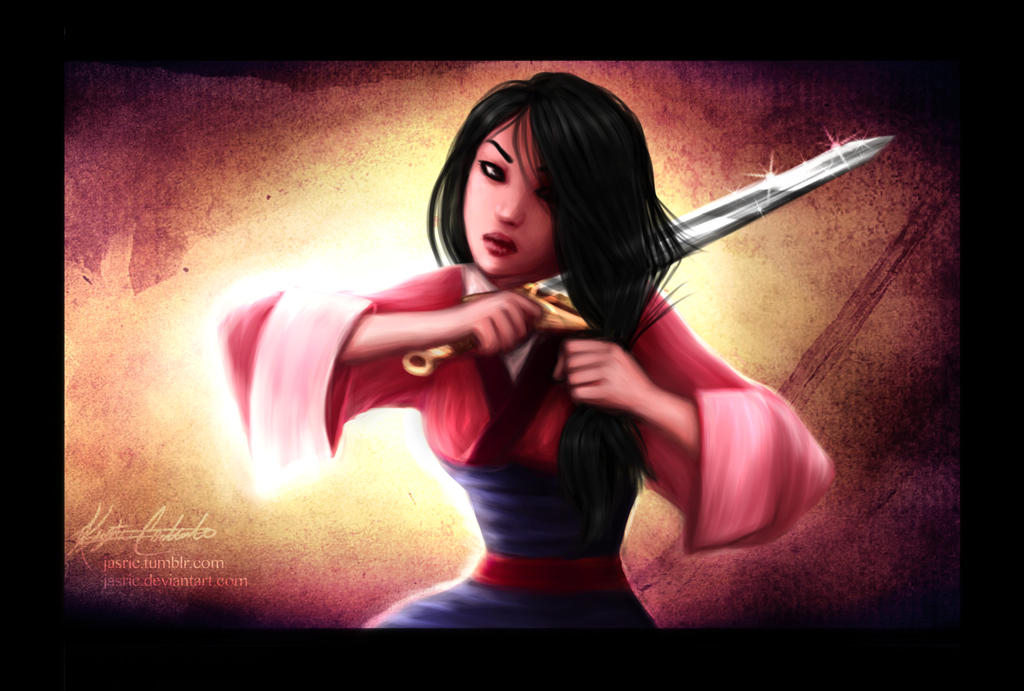
http://fc08.deviantart.net/fs70/i/2012/070/2/e/mulan_by_jasric-d4sew53.jpg

I think the fictional character in popular culture is Mulan. I know that as a reader, I should pick a literary character, but the fact of the matter is that books don't reach the most important audience for the future of American culture. There are three and four year old girls out there who aren't encouraged to pursue their unfeminine interests. Three years old is an impressionable age. Three years old is when you decide what you like and don't like. I remember when I was that young. I remember all of the Disney Princesses. I remember which princess wore what dress. It wasn't that I wasn't interested in science and engineering, but those things weren't presented to me as things I should be interested in. Then, there was Mulan. A woman who was pretty, but not comfortable just being pretty, so she went out and became a man for a while. And she kicked butt as a man and won the admiration of the men around her. She was turned aside for being a woman, but then she accepted her dual nature as a mix of masculinity and femininity, and she saved all of China doing that. That final fight scene, where she physically fought with fans and the like, that left an impression on me. The symbolism of her strength as accepting both parts of herself, with those fans... She was the strongest when she did that. I didn't get the complexities of it, but it opened a whole new way of thinking for little three year old me. Other girls need that, too, and more of it.

https://blogger.googleusercontent.com/img/b/R29vZ2xl/AVvXsEjssOvQ7C9cOv9BaX_oljVuB1SOy3_5VZEJzyJO8iglLAZ2yT60SIA1xxr2PRc6ogO6jvPt3BrA27FmJCNehq4yGPZrBmfIrHqDBf0wsvQhsLTa59dPZd4UoHePmOkwCvmB8gJJS0QoSgpI/s1600/angel-a+(1).jpg

If I had to recommend a have-to-watch movie, I think I would recommend Angela. When I think of magical realism, I call back to that movie. It has such an exciting, thrilling atmosphere... Something about it elevates it above a simple romance to something genuinely lovely. It's dirty. It's gritty. It's unapologetic. And it's heart breaking. I always cry when I watch it, and I didn't cry when I watched the opening scene of UP, just to let you know how serious that is. I have a soft spot for tall, in control women, and Angela takes the cake.
The IMDB doesn't do it justice.

Journal Seven By Megan Wittkopf

Part one:

I love my short-short story exercise with the picture. I love this story because I was able to make the story and characters relatable. I also love how I was able to show a life span through the story. When reading and writing now I am more aware of making a setting known in my stories. While reading I can picture the rise, resolution, and conflicts. I love knowing more terms like indirect and direct dialogue. Something I didn't know was short-short stories and learning about them, they have become my favorite type of writing (other than poetry). My goals for the last five weeks is to make my writing stronger and thicker (more detail). I have never written non-fiction fiction, so I am excited to learn about it. My final goal is to make my portfolio, I am very excited to have my work bind together and to show my family. My final goal is to go back and fix my work so it is perfected for the portfolio.

Part two:

1. My fictional character is Ponyboy from The Outsiders, S.E. Hinton. Ponyboy is my favorite because I love how genuine he is. Ponyboy and his friends grow up as street boys who learn through tough lessons (fights on the street, stealing, death). I love all of S.E. Hinton's books because she began writing at 16 years old.
2. I LOVE James Dean. Rebel Without a Cause is amazing. I had to write a paper about it my junior year and looking deeper into the plot Rebel Without a Cause is emotionally deep. Jim Stark (James Dean) is a rebellious teenager because of his life at home (parent's fighting) and takes on the role as a role model for Plato without knowing.  Jim also falls in love with Judy (Natalie Wood) because he is searching for the love his family doesn't give him. Jim always feels like he needs to prove himself by accepting dangerous challenges from other people (Chickie and racing). I love this movie because James Dean was an amazing actor and can speak to you through all of his body movements ( I also may think this because I am overly obsessed. haha)

www.youtube.com/watch?v=wXRgAXU1-T4 (Trailer just in case you've never seen it)

HE IS SO HANDSOME!

Journal Seven By Katie


Part 1:
My writing thus far has only improved because I didn't write and so the fact that I am writing now is an improvement. I have learned that I truly enjoy writing and want to take more classes for it in the future. So if anything from writing I have learned that I enjoy it. The writing exercise I believe has been my best has been my form poem. I felt I packed a punch into a small amount of writing and conveyed my feeling thoroughly. In my reading awareness I have learned that sometimes for the writer things come out of the blue and they are just as surprising for them as they are for reader. For the last few weeks my goals are to challenge myself in my writing, learn what I enjoy writing and don't enjoy, and to continue to try and find my own voice. I am aware that these goals will most likely not be accomplished in five weeks, however I hope to be able to take a step or two into the direction of me completing them.
Part 2:
     1) Trying to think of a fictional character that means the most to me was very difficult but I have settled on Jacky Faber, the main character from the Bloody Jack series by L.A Meyer. In these books she has lost her family while young, learned to survive as an orphan, gained an education, started a worldwide business and traveled the world. She is a quick learner, adventurous, witty, clever, as though scared a lot, she pushes through her fears because she knows  that she has to. She knew she wasn't perfect and admitted that very often, but she knew who she was and accepted the consequences of her actions when she had to. She is not the most perfect role model, but reading her stories have never failed to make me smile, not matter what else has been going on in life.
     2) The movie I am going to recommend is Good Will Hunting. I just recently watch this movie about two weeks ago and have watched it two or three times since. It's a drama but not a sappy, sad drama. It's a drama about a young intelligent man's life and figuring out who he is. The dialog is great, as is the directing and acting itself. It stars very young Matt Damon and Ben Affleck, and Robin Williams too. It is a bit intense but you feel a happy contentment at the end which I find nice. It is kinda long, like 2.5 hours but worth every minute.  Heres the movie cover:


Side note: The movie started as a college assignment for Ben and Matt. They had to make a 1-scene play and few years and money to make it later... Voila! This was created.

Journal Seven by Maddie

Part One:
One of the best exercises for me was exercise 7, This Moment in Time. For this exercise we had to pick a photograph and write in the voice of someone in the photo. I feel I did well with it because I had a lot of fun with the prompt. Exercises that had prompts less appealing to me I didn't do as well on. But for this one, I really enjoyed taking on the voice of someone from a real photograph. I could create whatever story I wanted to tell about them. As a writer and reader, I have started paying more attention to the word choice and tone being used. The words that are used are very important and can have a large influence on the story, much like the tone. I have become more aware of who the narrator is in my own writing and how to make the words and tone match who is speaking. In these last five weeks, I hope to improve on my actual writing process. When writing stories, I tend to just jump in and see where I end up. I found myself doing that with the 4-7 page story we are using for workshop and without a solid direction, I got stuck a lot. I think by doing it this way, I'm making it harder on myself so I want improve my process.

Part Two:
One of the most meaningful fictional characters to me is Jay Gatsby from The Great Gatsby. He is so intriguing as a character. I remember the first time I read the book I was in love with all the dimensions of his character because you can't quite figure him out. He fascinates you and draws you in because everything about him is a mystery. F. Scott Fitzgerald did an amazing job of creating someone that appeals to everyone. In the book and movies, the women wanted to date him and the men wanted to be him. In some sense, that holds true outside the story.

I would recommend others to watch Stuck In Love. It's not as big of a chick-flick as it sounds, I promise (plus it's about a writer). This movie has a variety of characters, so there is bound to be someone in this story everyone can relate to. There are a lot of powerful relationships between the characters, along with many emotions being expressed throughout. I'm pretty sure you can experience every emotion while watching this movie, without it being overwhelming. Bonus: it's on Netflix!

Wednesday, March 11, 2015

Journal 6: Ian Webster

Part One:
For me two interesting pieces were Hitman and Girl:
Well actually i wouldn't say Girl was one of my favorite poems, but it was just so interesting to read. These two poems are complete opposites. One literally documents a mans entire life from the big deals right on down to the small details. In Girl you have no idea the setting, the time frame or anything like that. It really is just providing a snippet into someones life, a life that no one knows anything about. While Hitman was quite the opposite considering it really documented this mans entire life from beginning to end. But a similarity could be that they are both two unorthodox writing styles that really flow in their own unique way.

Part Two:
I read it over a couple times to really feel the effect of the story but Reunion  definitely struck a chord with me. I liked it because it is so vague, and yet it is so clear, not like this statement. I think that the plot line is first of all unfinished, but also there is not enough of a backstory to really understand this story. But i liked that because it puts you in the moment, and makes you really visualize the story and what is happening. The story is essentially a father and son meeting for the first time in a long while, and the meeting not going quite how the kid hoped to put it in a nutshell. What this means to me is unclear, really, because i am still unsure of how i am suppose to approach this story, I'm not really sure what is suppose to mean to me, but it sure was entertaining. I think a reader can learn some good and bad elements of writing from writing in this certain style. I think that if u write using this notion that you are suppose to let the reader sort of figure out the situation for themselves, you have to give little cues in the story that can create an image in someones mind. Like the first sentence, he starts off by saying "The last time i saw my father was in Grand Central Station", you instantly know from that sentence that he is more than likely reflecting on a bad memory. My favorite word or phrase in the story i would say is Daddy, because this was him basically letting go of his childhood, essentially letting go of what paternal prescense was in his life, which would remind him of his childhood. The most important sentence i believe isn't really a sentence but a phrase "This isn't England". This i think sums up how everyone else feels around this man like the servers who are suppose to wait on him. How would you be able to be nice to a man like that?


Web reading exercise on Flash Fiction or Short-Short stories. From Mike Lohre.

 Dear students and fellow writers:

We've read some flash fiction, or short-shorts.  Now let's hear from some writers, and explore the limits of the genre.

Have fun, and I'll look forward to your responses in the Comments section of this post.

Mike


Going Long. Going Short.  Opinion pieces by writers in NY Times.

http://opinionator.blogs.nytimes.com/2013/09/30/going-long-going-short/?_r=0

The Story Behind My Very, Very Short Stories.

http://6thfloor.blogs.nytimes.com/2012/08/27/the-story-behind-my-very-very-short-stories/

“The Margin,” by Curtis Sittenfeld
In 1987, when Jenny Ficker and I were in sixth grade, our goals were to have a double wedding at which we married the McMasterson twins, to trick my sister into drinking a glass of pee and to sneak in the middle of the night to Boland Square and put a bra on the Grecian-woman statue on top of the fountain. Weirdly enough, I did marry Andy McMasterson, but I lost touch with Jenny years ago; whenever I drive by the Boland Square statue, the bronze bosom still hangs there for everyone to see.
“The Femur,” by Curtis Sittenfeld
On my 21st birthday, my father revealed two facts about himself: that he was colorblind and that before I was born, he’d served four years for armed robbery. I suspect the colorblind disclosure was a test of my maturity, and if I’m right, I must have barely passed. After he told me, I became petulant and said, “I just think it’s really weird you hid that for my whole life.”

Students, please respond in the Comments section of this post:


1)  What strikes you in the writer's essays as important?  Do you agree or disagree that flash fiction is perfect for the busy, technological age?  Explain.  Use one quote from the articles somewhere in your response.


2)  Are these two examples of very very short stories really stories?  Why or why not?  Argue for, against, or both?! 

Journal 6 Katie Vance


Part One: Popular Mechanics and Bottle Caps
I feel like these two stories are the most different because of their tone. Popular Mechanics' tone is very harsh and anxious. I felt like I was walking on eggshells the entire time I was reading it. In Bottle Caps though, it felt like the tone was "matter of fact" like she would tell this story in the same tone if you asked her what time it was. Another difference between the two are the ages of  the main characters. In Popular Mechanics, the main speaker was an adult while in Bottle Caps it was a young child. A similarity between the two was the fact both stories took place at home. In Popular Mechanics, the father was leaving the house and packing his things. In Bottle Caps, the speaker talks about their collection growing in the basement and their backyard where their brother had and insect graveyard.

Part Two: The Old Badger Game
This was my favorite story out of the 7 because it talked about badgers and it made me laugh. I think this story means to not dislike others for living a different life from your own. Though it is a different life, there may be more similar problems between the two than originally thought. A writer can learn a lot about personification from this story. Annie Proulx wrote about badgers having jobs and being retired and did a fantastic job of it too. The most important word would have to be rancher. This is because it helps with setting, and what some of the characters do for their job. It allows for the badgers to be in the story in a realistic setting of their natural habitat. This helps make the personification seem more realistic. The most important sentence was " 'Good looking badger,' she said aloud, imagining herself in a coat of the same red hue, not necessarily a fur coat- a faux fur would do, or even tweed with a monkey collar." This is the most important sentence because it is the lever in the story. It pulls the first half of the story into the second half where the conflict lies seamlessly in one sentence.

Journal 6 From Megan Wittkopf

PART ONE:
Popular Mechanics is a short short story about a husband leaving his wife and wanting to take the baby with him. The short short story's setting is in a house. It is also written in 3rd person limited, unreported dialogue, and has one conflict. The conflict is also extreme because some of the actions performed with the baby are unrealistic (baby was in the middle of a tug-of-war)

Bottle caps is a short short story about a guy who likes to collect all sorts of bottle caps.  His younger brother has been taking his bottle caps and has been using them as headstones for his dead insects. The short short story is written in first narrative reported dialogue, only has two characters, and one conflict (brother taking the caps).

Similarities:
short short stories
both have conflicts

Differences:
Both are written in different dialogues
Popular Mechanics has a more relatable conflict
Both are written in different voices

PART TWO:

My favorite short short story was Reunion by John Cheever.

1. Reunion is my favorite story because it reminds me of my father, somewhat. My father is not as extreme but he would get into ridiculous conflicts with cashiers, people on the phone, etc. When I was younger I was embarrassed but now I understand why he was mad! It also could be I have his temper!
2. What I got out of the story was an adult man traveling by train and had a stop in New York. His father was not around as a child so he was looking forward to seeing him. When his father met him he seemed cool till they end up going to four different restaurants because of his father's rude behavior. By the end of the story the son left and never visited his father again. What this story related to me because I am a server and I have had people treat me in the same manner. I just don't have enough courage to tell them to leave. What is sad is there are a lot of rude people like this.
3. A writer can learn how to change scenes like a circle and ending in the beginning. For example the story starts at the Grand Central Station and moves to 4 different restaurants and ends back at Grand Central Station. The writer also introduces us to 5 different characters other than the main 2 characters. What a writer could learn from this is that you can introduce many characters with a small but huge role. Without the servers (small role) we wouldn't be able to see the rudeness from the father (huge role).
4. The most important word is boisterous because it explains the father's attitude. Boisterous means noisy, rowdy, which when his father was being rude he was being loud and rowdy to be heard from everyone, as if he wanted the attention.
5. "Now, just wait a second, sonny," he said. "Just wait a second. I want to get a rise out of this chap." This is an important sentence in the story because the sentence proves that the father was acting rudely to see how far he could push the servers/employees. It seems like a game to him to act rude and to see if someone will act rude back and how rude they will go (like a shouting match).

Journal Six

I know it's strange, but I think that Popular Mechanics and Reunion are the two most different stories. It's a matter of tone, really. The tone in Reunion is wry and sly, like it's winking at you out of the corner of its eye. Popular Mechanics is dramatic and understated, and each sentence is packed with tension. The more I read of Popular Mechanics, the more nervous and anxious I became, because while it started out bad, I know as a reader that short stories like that tend to only get worse. The more I read of Reunion, the more I relaxed. I laughed, even, and wondered how much more troublesome the father could be. Reading one after the other was a serious cause of cognitive dissonance.

I think my favorite short story out of the selection was Symphony. I wish that I could put a date on when it was published for more context, but I can't. It seems to explore the life of a supposed slut, and how fantastical people make it sound. In places, it's remarkably tongue-in-cheek- "I woke up in Phillip's bed. Come here, he's in my hair. You can smell him."- and in other places, it's quietly poetic: "After the only part of him I will ever hold collapsed inside me he said 'You are so incredibly gentle.'" I think the best craft to take away from Symphony is that you often need to go outside of your comfort zone to find topics to write about that no one else has written about, to be original. So many authors shy away from talking about sex and love in fear of being thought of as silly and frivolous, but there's so many unexplored complexities and nuances in those two concepts.

Sacred is possibly the best word in the story. It's strange in a story about a woman who sleeps around often, with so many people that the act of sex isn't special, but that makes it stand out more.

Sacred:
a :  unassailable, inviolable
b :  highly valued and important <a sacred responsibility>

Sacred means precious, beyond reproach. It's a word associated with religion and a higher power. 

"I lost fifteen pounds and the men want me again." I feel like this is the most important sentence in the story because it's so ridiculous, and it calls back to the sort of nasty things ladies say about one another. "She got skinny and now she's a slut." The entire story gains perspective with this establishing sentence as being fantastical and silly. 

Journal Five

Dear Mr. Levine,
We watched a DVD interview of you in class a while ago. I was surprised by how... Down to earth you were. I have this fixed image in my head of the stereotypical poet being a dark and brooding young man who wears fedoras and shaves his beard into the shape of a goatee while sipping on a starbucks latte. It took me ten minutes to realize the backdrop of the interview was an outside gym. You look so unassuming. I would have figured you for a blue collar worker, not a poet.

But you are a poet! I admit, I wasn't paying much attention to the film until you started reading M. Degas Teaches Art And Science At Durfee Intermediate School, yet it caught my wandering ear and kept it for its entire duration. I grew up attending mediocre city schools. I was the Gertrude of the class; always over-sharing and never wrong. Oh, who am I kidding. I'm still Gertrude to this day. You can ask my professors. Your reading of that poem made both me and the class laugh, and it called me back to a bright spot in my childhood.

I hope the other side appreciates you more than we did.
-DD

Journal Six from Maddie

Part One: The two poems that I feel are most different from each other are "Reunion" by John Cheever and "Girl" by Jamaica Kincaid. In Cheever's story, we get full sensory details of an event that was over in an hour and a half. In Kincaid's story, we are seeing glimpses of her life over a continuous time span. A large difference between these two stories comes from the construct of "Girl". The story reads more like a list, composed of rules that are being said by a character we never meet. Also in this story, there are a few sentences that seem to be unreported dialogue, coming in the form of questions. "Reunion", however, is formatted much differently in that it uses reported dialogue and relies heavily on on the dialogue happening between the two main characters. A final difference between these two stories is the way the author reveals setting. In John Cheever's story, we are immediately told where the story was taking place. after the first two sentences, we know a father and son are meeting in Grand Central Station in New York to get lunch. In Jamaica Kincaid's story, we get clues throughout that suggest a setting. Some of these clues, such as benna music, doukona pudding, and many others, let us know that the narrator of the story is from a culture different from our own.
Both of these stories are told in the same first person point of view. For "Reunion", we see everything from the point of view of the son. We get his thoughts a feelings as he tells the story of the last time he saw his father. In "Girl", there are two lines that suggest that it is also written in first person. The unseen character is giving the narrator guidelines and the narrator responds to only two of them. These responses are italicized in the passage. The narrator says "but I don't sing benna on Sundays at all and never in Sunday school." The use of "I" is evidence for a first person point of view.

Part Two: 1) My personal favorite was "Bottle Caps" by Stuart Dybek. I thought the story had a charming tone, except for the climax of the story when the narrator found his brother stealing his bottle caps. I also enjoyed the resolution that followed the climax when the narrator found out why his brother was stealing them, which gave it an amiable ending. 2) I interpreted this story exactly as it was read. I pictured two young boys finding a way to pass their time in the summer. The narrator had the hobby of collecting bottle caps, something he is very proud of. And the younger brother enjoyed burying insects in a self-made graveyard. It gave me the impression that it took place many years ago since I never heard of kids today collecting items out of the trash or creating things in the dirt. 3) The writer does a great job of using sensory details to make the reader feel what the narrator was experiencing, "The coffee cans stashed in the basement began to smell- a metallic, fermenting malt." The writer also uses the perfect amount of dialogue. There are only two lines but the writer could have added more or less. But with only two lines, it was enough to capture the moment of what was happening for these boys, but not too much that the story relied on it. 4) In this story, the most important word the writer chose to use was "hoarded". Up until the very end, that one word captures everything the narrator is doing with these bottle caps. They were so important to him and he held onto them so much, that they became beautiful to him. When we hear the word "hoard", we give it a dirty connotation. In reality, the word "hoard" isn't a negative term, it means a supply that is hidden or carefully guarded for preservation or future use. While many assume that hoarding means living in filth, the narrator of this story thinks what he has done is beautiful. 5) The most important sentence in this story happens to be the very last one, "I've been using them as tombstones," he said, "in my insect graveyard." I love that the story ends here, because it didn't have to. The entire story, we are given the impression that these bottle caps mean a great deal to the author. Even though he has more than he can count, and so many he doesn't notice when some went missing, he still refuses to get rid of any of them. When the younger brother tells him he has found a new purpose for them, it leaves us with the impression that maybe the narrator will appreciate the usefulness his bottle caps serve and accept it, rather than stashing them away in coffee cans in the basement.

Monday, March 2, 2015

Journal 5: Ian

Dear Mr. Levine,

I was really captivated by your interview. I really enjoyed how you put your life into perspective with others in order to make a bigger point, one of the few things i picked up on. You talked about how life growing up in Detroit was both a blessing and a curse at the same time, but you really didn't know why. I think it is really clever saying this because it is what you do with our very limited amount of time on earth, so you should exclude all of the bullshit.

I think it is interesting being such a distinguished writer and not really even being recognized for your work, but i think you made a good point in saying that it isn't that part that drives a poet, it really is done for oneself and oneself only. You don't do it for the glitz and glamour that some authors strive their entire lives for because that is really how they are going to make enough money to have anything evoking a normal life. But that doesn't matter, and thats how i think it should be with any profession, but obviously that will never be the case.

I enjoyed the poem You can have it, it seems like so many elements of writing are being put to use here, although it being for the most part a reflective poem. You are talking about how you could give your brother more than what you could give him at the time in the 1950's in Detroit, I really enjoy the thematic theme, and how it is a story. I really like the line "The City Slept. The snow turned to ice. The ice to standing pools or rivers racing in the gutters. The bright grass rose between the thousands of cracked squares, and that grass died". That is a case of sensory overload, to the fullest, yet you are also telling a story.

I hope to take what i have seen from you and apply it to my own writing, it might take some time and experience, but maybe someday it will come to me.

Wednesday, February 25, 2015

Journal 5 from Katie Vance


Dear Mr. LeVine,

     Before watching the video about you in class, I am ashamed to admit I have never heard of you. I am ashamed to admit that because I liked that video ad wish you were still around so I could learn more about you. It is sad you are no longer here, but your words and poems will live on in the books you have published. Death has not stopped you. You will be able to influence lives long after your death, as long as a reader picks up your book. What struck me most in your interview was how down- to-earth you were. You know how the world worked and that was that. You had your opinions, realized others would disagree with you but that was alright with you. I hope that I am able to be so warm and welcoming to others as you were. If I can achieve that warmth, then death will not stop me either because simple acts of respect and kindness can influence/ change other's lives.

       One thing that struck me from your interview was how you went back and explained your different opinions from the different stages of your life. It showed me how much one can change over the years without becoming someone bitter. It showed me people can grow old and still enjoy life, more so in their later years than their earlier ones. You said you were depressed in your twenties. I find that difficult to believe. Maybe the years were kind to you and helped changed your view. It shows me that I should still continue to wish the best for people even if they seem like meanie heads.

       My favorite poem you shared was "M. Degas Teaches Art and Sciences At Durfee Intermediate School." The way you were able to capture the students viewpoint of a long class was incredible. I have sat in classes where I knew they were going to be long, and I had longed for escape. Even though I have never been to Durfee Intermediate school, I have sat in classes where I felt like the speaker.  The lines "...the room stilled until the long hand of the clock went ti twenty one...and I knew this could go on forever" made me laugh. M. Degas seems like a teacher who wants a specific answer, yet none of the students know what it is so he keeps making them guess. I have had teachers similar and those classes do go on forever.

      I want to read more poems written by you. It seems like it would be fun. I hope you are happy with the life you lead. It seems like it was a fulfilling one for you.

Sincerely,


Katie Vance

Journal 5 from Maddie Nicol

Mr. LeVine,

I greatly admire your modesty and wisdom. You began writing poetry with the intention that it wouldn't last, and in fact, you joke about ever becoming a poet. Thankfully, you did decide to pursue it and shared with the world some terrific stories from your youth, which may not all be true, but the secret behind that will forever stay with you.

I think it's an important subconscious decision not to let death stop you. One of the most relatable things you said in your interview was that you are more afraid of losing someone close to you, such as your wife, than dying yourself. Personally, that, too, it one of my biggest fears. With that being said, the anticipation of death will never stop me. In fact, it has to opposite effect. Ultimately, all I want in life is to experience as much as I can before death, and that includes spending as much time with those who mean most to me.

One of my favorite poems from your reading was You Can Have It, I say 'one of' because they were all terrific. This poem really gets into what it was like for you growing up, including having your twin brother there will you. Being raised in Detroit during the Depression is sure to leave an impression on anybody. Perhaps that why you identify your earlier books as being bitter and angry. My favorite lines of this poem are "We were twenty for such a short time and always in the wrong clothes, crusted with dirt and sweat. I think now we were never twenty." Being the time and place you were in, you must have never got the chance to live like a twenty-year-old today would. This poem also shows how large a role those most important to you play in your life. You recognize that together you are one man, sharing a heart, hands, and a mouth, and that is a powerful statement.

Your poems will continue to fill its readers with all the wild emotions you intended them to have for years to come. Thank you for sharing you stories the best way you knew how.

Warm regards,

Maddie Nicol

Tuesday, February 24, 2015

Journal 5 from Megan

Mr. LeVine,

             I really enjoy your sense of humor. Your poems and stories enthrall me and leaves me wanting to hear more. In your interview you spoke about how death doesn't stop you. That there is certain things about death that frighten you, like the death of a child or love one. I feel the same way. No parent should have to bury their child. Personally, I could not picture that for myself, I would fall apart. Death itself terrifies me. I am studying to be a nurse/ultra sound tech and I will be dealing with death. I have only dealt with death once in my immediate family and with that only experience I don't know how I will handle death of varied ages and loved ones. I don't even think I could tell someone that their child/ loved one didn't make it. But, since this is my dream job I will have to learn to accept the naturally of death. My death? I'm not gonna lie, I think about it. There are days I accept the fear and days I deny I will ever die. The fear of death will not stop me from my dream job or from my living my life because death doesn't have a date so we must live while we can.
          In your interview you spoke about how you had a dream about your friend calling you and you directing him to all these sights he wouldn't be able to afford and when you awoke you thought of yourself as an asshole. You said you found this dream superstitious and took a week off work to lay in bed and write poems. I don't understand what you were superstitious about? You worried that you weren't making enough money and felt like you needed to write to make money? Or were you worried your friend was coming? The poems you wrote over and over that week were about the friend and the dream in different aspects. Would you please explain this further?
         There was two poems that really stuck out to me, The Theory of Prosody and M. Degas Teaches Art And Science At Durfee Intermediate School- Detroit, 1942. I can relate to both of these poems, but my most favorite was The Theory of Prosody. I love this poem because I personally have two cats. You described them perfectly in this poem (even though the cat has nothing to do with prosody). The line- "When Nelle was in her prime she used to sit behind me as I wrote." My cats, both, try to squeeze themselves behind me while I do anything with paper or the computer. If I have papers lying around, they will lay on them. If I set my pen down, I will find it knocked on the floor. Sometimes when I write the cats will pat my hand because they wish I would pet them. I also am comforted by my cats, they will lay in between my laptop and my stomach or in bed they will both lay by my chest. This poem was my favorite because even though the poem's title is about prosody, the relationship between a writer and their cat is perfectly executed.
       Thank you for sharing your poems and stories with us. They will forever be read and told to many.

With Regards,


Megan Wittkopf

Wednesday, February 11, 2015

Journal Four: Ian

Part One: Hugo i think has an interesting style of describing his surroundings and how life was happening right in front of him. Chapter 8 of hugos book deals mostly with his trip to Italy during WWII. He recounts on page 77 his encounter in a tiny hotel bar, seeing only English soldiers in this tiny part of Italy. "One day in Foggia, I found a little hotel bar. The only other people there were the bartender and three English soldiers". He seems to explain the small details that an average reader of literature such as myself would not notice or even forget. He takes those tiny little details and creates a great sense of feeling and really seeing the location through literature. There were bigger things going on in the world at that time, but he was only focused on what was right in front of him.

Chaper 9, titled "How poets make a living", i thought was going to be rather interesting because i still don't know how a poet could make his or herself a comfortable living, hell authors make barely any money, so how can someone make any kind of money from writing 20-30 lines of mostly rhyming words? These were some of the questions that i thought of when reading this chapter. Hugo seemed to sum up his career on the last page of the book. "I suppose I haven't done anything but demonstrated how I came to write a poem, some what turns me on, or used to, and how, at least for me, what does turn me on lies in a region of myself that could not be changed by the nature of my employment" (109). I think the point he is trying to make is that he does not look at his occupation as being a poet, it is more of a lifestyle and way of expressing ones feelings and inner thoughts, I don't think he even cared if he got paid for his work or not. Because to make money a book of poems has to be published, your private work, out for the world to see. Some people seem to like the private side of writing poems, you do them for yourself, not necessarily for others. I think he means that one has to really have a passion for the craft, in order for it to take them anywhere in life.

Part Two: Making poetry is something that I think is much more satisfying than say writing a paper for an english class, because it gives you all the freedoms that you would ever really desire in writing. Essays always have to go by a prompt, and usually you end up changing and altering the paper in order to fill those requirements on the rubric, sometimes completely ruining the point you are trying to make because you don't know how to explain it. I have struggled for a number of years trying to wrap my head around this concept and i realize that nothing is really ever going to change because that is as important a skill as any you can take away from primary and post-secondary education. Writing poetry, you still have to abide by the boundaries set by the type of poem that you are trying to create, but that is pretty much it, and thats what i like. You can write about what you want, and you can write it the way you want to write it. And learning to balance those two skills can be something that will really help me in whatever career path i choose, the ability to write effectively to garner a response from the reader. If you can do that, the world is your oyster.


Journal Four

In chapter eight Hugo speaks about reputation and how it is hard to understand how anyone nice could get into a war. I like the quote " I didn't know how good the poem would be but it would be honest and I would like it  because it wouldn't be any  tougher than the human heart needs to be." I feel like he is telling us to soften our hearts towards others. Just because a place has any sort of a reputation, doesn't mean we need to toughen our hearts or hide our hearts from them. We need to be equally loving to everyone, not just the ones who are hospitable towards us.

Chapter 9 states "But no job accounts for the impulse to find  and order those bits and pieces of yourself that can come out only in the most unguarded moments, in the wildest, most primitive phrases we shout alone at the mirror. and no job modifies the that impulse or destroys it." I love this quote especially because he is referring to a job for a person not just a poet. He is correct though, no other job would let you show every aspect of you. yes. you'll be judges, but those people leave and the others will understand and accept you.

 What I have learned about my poems, comparing them to our books, is that I can write different styles with the help from our books. Similarly I could use metaphors and free verse. Differently I never thought about how important enjambment can be and how it can change a poem drastically.  Another difference was the use of stanza's to help my poem form. Similarly, I understood the basics of poetry but the book helped me learn how to make the basics better, overall better poems.

My process from writing a poem is to find a topic, style, and method of writing. Once I begin writing my first "mood" will most likely change. I write in free verse to help get all my ideas and words on the paper. When I need to rhyme, this is where I begin to struggle. When using symbols, octaves, or sonnets, I focus so hard on rhyme that I feel like it comes doesn't come out well. I  am not satisfied with the poem because I don't feel like I have said everything I wanted to say thus the poem feels fake and cookie cuter to me.

Journal Four from Maddie

Part One:
What I loved about chapter 8 is how much Richard Hugo took away from his first trip to Italy. He took complete advantage of being somewhere foreign. Most war stories are about just that, the war. But there was so much more to his story, and he took so much more in. He remembers specific encounters in places as trivial as a hotel bar, "One day in Foggia, I found a little hotel bar. The only other people there were the bartender and three English soldiers" (pg 77). He continues after quoting their conversation, "I've never forgotten that exchange. They seemed worldly to me, their view wide and deep" (pg 78). There is just something so real about how he tells his experience of WWII. On page 85 he talks about a casual run-in with a native woman and her asking him for cigarettes, which he denies her for. He goes on to say "I've made far worse mistakes than refusing that woman cigarettes, but no mistake came back so often." I know I can relate to the feeling of having one specific regretful memory return to my mind time and time again, even if it is silly.

From the title of chapter 9, "How Poets Make a Living," I thought this chapter had nothing to offer me, but of course Richard Hugo proved me wrong. On the final page of the book, Hugo writes "I suppose I haven't done anything but demonstrated how I came to write a poem, sown what turns me on, or used to, and how, at least for me, what does turn me on lies in a region of myself that could not be changed by the nature of my employment. But it seems important (to me even gratifying) that the same region lied untouched and unchanged in a lot of people, and in my innocent way I wonder if it is reason for hope. Hope for what? I don't know. Maybe hope that humanity will always survive civilization" (pg 109). From this, I took that it is important to not forget who we are. Regardless of our environment, our work, or any other factors, that part inside of us must never be changed by the outside world. This holds true to everyone, not just poets.

Part Two:
I have taken in a lot of the advice Richard Hugo gives in this book. As someone who has virtually no experience writing poems, I found almost everything he discussed helpful. Before this book, and this class, I would have written a poem based on what each sentence literally meant. I would have never thought throwing in a word simply because you like the sound of it would work, but clearly it does. There have been times where I have gone back and tweaked my poem for class after reading a section in Hugo. As far as my individual writing, the setting I write in is important. Every poem I have written has always been done sitting at my desk at home listening to music, but there can't be any lyrics in the music or I can't hear myself think. I find myself struggling most with my first two lines. The start of my poem is always the most difficult, however I am sure that's not uncommon. I'm looking forward to our work shop day and hopefully getting some great feedback on my poem!

Journal Four: Dana Dreher

The most important idea in chapter eight, for me, was that World War II wasn't just a story in the history books. I'm young - I'm turning 19 in 11 days - and World War II was 4 of my lifetimes ago. One generation from now, only the history books and the old black-and-white video tapes will remain. Reading about Hugo, someone who has almost modern takes on the writing process talk about WWII so personally, in non-archaic language, makes it seem so real.
He even has the gall to crack jokes about that sober time. "We won. If you had seen me bomb, you might have doubts."
I'm not learning much from making my own poems, frankly. Something about the technical aspects of making poems isn't clicking in my head. I've spent ten minutes trying to decide if except is two syllables or one, only to get the wrong answer. I've tried to sit down and figure out iambic parameter, but the phrases "stressed syllables" and "unstressed syllables" are gibberish to me. I'm not a bad student. I'm not awful at english. Yet when I sit down to write my own poems, a single stanza can take forty five minutes and still be garbage.
I'm not looking for praise. I love reading poetry and writing fiction. Trust me, I know the quality of poem I am producing.
I've been learning the most from reading the poems the book has selected and seeing them discuss the elements of the professional poems. I love reading poetry! I do enjoy poetry. I'm learning a lot about it. But I'm struggling so much with creating it, in a way I've never struggled before.

Journal Four: Katie

Part One:
In chapter 8 of Triggering town, I think the fact that Hugo tried to be someone he wasn't was an important idea. Hugo tried to be a brave man while the war was going on and when he returned he came to the conclusion he won't ever be a brave man. This is important because it seems people tend to aspire to be like someone else, and feel like they always fall short. Once Hugo embraced his sensitive side, he felt better about his experience in Italy when he returned. He states "I am not sure why I'd come back, but I felt it must be the best reason in the world." Hugo went on a journey to finally come to peace with himself, and I think people, including me, show learn from his experience so we do not waste time in our lives.

In chapter 9, I think the idea that is most valuable is the idea that everyone is human and deserves to be treated as such. He claims he worked with  a man named "C" and the that "C was easy to dislike if you only saw his surface." Then he goes on explaining why C was misunderstood, and that even he (Hugo) realized C was a person with feelings and deserves to be treated as a human. I think it's a lesson everyone should learn, and if people treated each other with more kindness then the word would be a happier place.

Part Two:
Learning poems from the book is helpful because it helps me get my ideas out onto paper in a way readers can understand it (hopefully). However the bad thing about the book is that it sometimes limits my ideas into a certain amount of line and syllables. Either way my poem is created and I feel better because of it!

My process of getting poems starts with me finding inspiration, which can be very tricky to find. Once I find it, the rest of the poem comes much more easily for me. I may have a difficult time finding the right word or phase, but that gets remedied soon enough. I tend to struggle when I have a great idea and I see the picture of it in my mind, but I have no idea how to transfer the picture into words. I tend to get all worked up, and no work can get done when I am in that state. I also like to write when it is quiet, so my opportunities are slim on when I can write because I tend to be around noise more often than not. Writing poems is not always the easiest but I am able to write them eventually.

Monday, February 9, 2015

Reading connections for the last Two Chapters of Hugo. From Mike Lohre

Students,

I tried to do a little research and internet work to give me a sense of place and time for Richard Hugo's book.  I was struck by how important it was for him to go back to Italy, even 20 years later, to try to find places and memories that he could not escape.  In some ways the trip is a metaphor for writing.

Here's some fun stuff about Italy, the times, the food, drinks and the cantinas he spoke of as now being lost to globalization.

Popular songs during the war:

http://youtu.be/kOO8Gzr__zc  Benny Goodman song "Don't Be That Way"

http://youtu.be/j2fbOAyNOpM  original Stardust by Hoagy Carmichael

http://youtu.be/DjU6ZjrQulc  Stardust later made popular by Nat King Cole

Food and drinks they spoke of having in Italy


Pasta e fagioli, meaning "pasta and beans", is a traditional meatless Italian dish, with peasant roots.  Now in vogue in all social classes.
See website for more on this popular plum brandy.

http://postprohibition.com/liquor-cabinet/strega/

Strega.  


http://www.slivovitz.us/

http://drinks.seriouseats.com/2012/02/what-is-slivovitz-best-brands-plum-brandy-marska-navip-rudolf-jelinek.html


Language


https://translate.google.com/?ie=UTF-8&hl=en&client=tw-ob#it/en/troppo%20fame

Troppo tensione.  Troppo miseria. Troppo fame. means "Too much fear.  Too much misery.  Too much hunger."

https://translate.google.com/?ie=UTF-8&hl=en&client=tw-ob#it/en/come%20mio%20fratello

come mio fratello means "like a brother"

Places and Maps


Cerignola
https://www.google.com/maps/place/71042+Cerignola+FG,+Italy/@41.2626817,15.896163,9z/data=!4m2!3m1!1s0x13383195503ac599:0x40f7058ccbfd0d2e

Huge stone church in Cerignola.


Spinazzola
https://www.google.com/maps/place/76014+Spinazzola+BT,+Italy/@40.965786,16.0895029,10z/data=!4m2!3m1!1s0x1338431450de3d31:0x7f25e56c0f90a5d7

From the 460th Bomb Group historian, writing about Spinazzola:
"Records show that Spinazzola existed as far back as the third century B.C. It was situated along the Roman road known as the Appian Way, which extended from Rome to the port city of Brindisi on the southern Italian coast. Opened in 321 B.C.,this road was built to connect Rome with the southern provinces of the peninsula, with Africa and the East. One could travel from Rome to Brindisi in 13/14 days. It is probable that most who served with the 460th Bomb Group (H) were unaware that the narrow, dusty tree-lined road that ran along the north side of the 460th air base was so historically significant."
Seattle and Boeing. Where the Admiral lived.

https://www.google.com/maps/d/viewer?oe=UTF8&t=h&ie=UTF8&msa=0&mid=zjuyk18FfWKU.kmXvsVROgIUo

This was Boeing Plant 2 and the company actually built it to look like a village from the air to keep it from getting bombed.

B-17 Flying Fortress, the most famous product of these Boeing wartime plants.
From Boeing website: "Companies around the country coordinated their war efforts. B-17s were built at Boeing, Douglas Aircraft and Lockheed Aircraft factories. As American men went to war, women built airplanes. Thousands of women, symbolized by "Rosie the Riveter," took up the slack in the workforce, both at Boeing and at the Douglas Aircraft Co. At Boeing, they helped boost production from 60 planes per month in 1942 to an astounding 362 planes per month by March 1944 -- at one point the Seattle plant rolled out 16 planes in 24 hours. A total of 12,731 B-17s were produced around the country; of these Boeing built 6,981."

Wednesday, February 4, 2015

Metaphor Found Poem Exercise from Dana

Your touch is like

like the motor
of a Harley
Revving
after a long winter.
Stuck, want to Go
Running

like Still sand Through the cottonwood tree
green leaves- comforted, yet unsure.
feel invigorating Wind in my hair.
school student’s hot holiday summer days.

and what will happen?
everyone’s got to suffer To Get To a reunion
where they party.

being in elementary school
family Driving you

where they like.

Metaphor Found Poem Exercise from Katie


Your touch is


Like an alarm that won't turn off
        and only grows louder
Like the motor of a Harley
        revving up after a long winter
Like driving to a family reunion
        unsure about what will happen and yet
              you still feel comforted
Like wind through the green
         leaves of a cottonwood tree
Like running through a sprinkler
        on a  hot summer's day,
invigorating

Monday, February 2, 2015

Metaphor Found Poem Exercise from Maddie Nicol

Your Touch Is Like

Like wind, through the
green leaves of a
Cottonwood tree.

Like the feeling of 71
on my skin,
when I'm going on 75.

Like running through a
sprinkler, on a hot summer's
day, invigorating.

Like living in a hurricane, where
you get swept up in the excitement,
and forget how to live.

Like being in a pinball
machine, and I don't know if i'm
blinking points, or ready to shoot
straight down the drain. 

Your touch is impossible to forget.

Metaphor found poem exercise from Ian Webster

Your Voice is like...


like living in a hurricane, 

where you get swept up in the excitement, and forget to live

like being in a pinball machine,

and i don't know if I'm blinking points

like an alarm clock that won't turn off,

and grows louder


Metaphor found Poem Exercise from Megan Wittkopf

Your Touch Is Like

Like sand,
stuck in my hair.
Like the motor of a Harley,
revving,
against my skin.
Like living in a hurricane,
where you get swept up,
in excitement, and
forget,
how to live.
Like wind,
through the green,
leaves of a Cottonwood tree.
Like running,
through a sprinkler on a
hot, summer's day,
invigorating.

Katie Journal 3


The English Canon By Adrienne Su

Its not that the first speakers left out women
Unless they were goddesses, harlots, or impossible loves
Seen from afar, often while bathing.

And it's not that the only parts my grandfathers could have played
Were extras in Xanadu,
Nor that it gives no instructions for shopping or cooking

The trouble is, I've spent my life
Getting over the lyrics
That taught me to brush my hair till it's gleaming,

Stay slim, dress tastefully, and not speak of sex,
Death, violence, or the desire for any of them,
And to let men do the talking and warring

And bringing of the good news. I know a girl's got to protest
These days, but she also has to make money
And do her share of journalism and combat,

And she has to know from the gut whom to trust,
Because what do her teachers know, living in books,
And what does she know, starting from scratch?

Part One: This is a free verse poem, written without meter. I also noted there is some consonance throughout many lines, like the fifth one with the "x's" sounds. It also occurs in line 10 with the "st" sound. The lines form a tercet and well because each stanza has 3 lines within it.

Part Two: I believe this poem is about the author coming to terms with herself and her capabilities. She knows the stereotypes given to women and though they are there, she wants to live outside the box. I feel like the tone is somewhat blue. Not bitter, not depressed, not melancholy, but more of a matter of fact type of tone.  It makes me think because it bring into play a lot of differing sides of being a woman, and whose words to listen to.

another thing

I kind of like the sound
of bitch-   such a word,
seems to leap right off the tongue:
reminds me of a woman looking
 directly at a man
  (and he doesn't like it)
of a woman fighting with her kids
  (but they need it)
of a woman needing something real
 and swearing at the world
  (and the world doesn't have it)
reminds me of when I have to
reach right down
inside me, right into
the fleshy hurt and let it
come inching out-then bursting out
by way of laugh/cry, and cry
being the best of all because then
the ocean that lives within
me shatters the seawall
of my reason
and washes over my sandyface and
I catch them on my tongue
and replenish the salt that evaporates
between tidal waves;
and maybe when I'm
reaching down to
fathoms of this sea
I never dreamed existed,
and the pull of the moon is
stronger than usual,
 maybe I look like a bitch, probably
because that's what
I am.

I think this poem is a prose poem because it doesn't have stanzas and I don't think it fits into any of the other forms. The tone seems to be light, but the more you read, the more serious the poem is. It's almost a juxtaposition where she's like "I like this offensive word," (making fun of it, being light) then she's like "of a woman fighting with her kids" (suddenly serious and dark.) She's got a powerful metaphor where she connects the idea of laughing and crying, but mostly crying to being like overcome by the sea. She's got all of this imagery about the beach and it's easy to get lost in it and forget she's talking about crying, but that's okay because it's the same feeling. You get the same feeling from the two, so if you get lost and forget what the metaphor was about.
I love this poem. Especially that last metaphor, where she's crying with the sea metaphor, and then the sea metaphor becomes a metaphor for deep emotion. "Maybe when I'm reaching down to fathoms of this sea I never dreamed existed, and the pull of the moon is stronger than usual, maybe I look like a bitch, probably because that's what I am." She's saying that yeah, when she's being emotional, deeply emotional, she's a bitch. Because that's what she is. It's like the entire poem is a response to some jerk who called her a bitch for feeling deeply and expressing that emotion.

Megan Journal Three

Teaching the Ape to Write Poems

They didn't have much trouble
teaching the ape to write poems:
first they strapped him into the chair,
then tied the pencil around his hand
(the paper had already been nailed down).
Then Dr. Bluespire leaned over his shoulder
and whispered into his ear:
"You look like a god sitting there.
Why don't you try writing something?"

This poem uses imagery- mental pictures or impressions that evoke one of the five senses. You can picture perfectly, in your mind, that there is an male ape who is strapped into a chair, pencil tied, and about to write. This poem is free versed because there isn't any meter or rhythm meter. This poem uses enjambment- the alternative to breaking a line at a mark of punctuation is to wrap it in the middle of a sentence so that the related words are different poetic lines. There is a use of end-stops- a period, semi colon, comma, or dash throughout the enjambment of the poem (high lighted in yellow)

I personally love this poem because it makes me think of evolution. I feel the mood is poking fun because it plays with religion and evolution, "you look like a god sitting there" but yet they're trying to make this ape write, evolution. I like the imagery and the enjambment. Each line read I can picture and then the next line adds to the picture to see the total scene at the end of the poem. Science shows how apes and man are closely related but yet they still tie the pencil and nail down the paper. It kind of mocks science's comparison to man. Even though the first line says they didn't have much trouble teaching the ape to write, it sounds like they had some trouble! I just love how it can have so many meanings and can sound sarcastic and then sound simple and funny, or it can mock a huge religious argument!